Understand your body. Honor your changes. Create a life that supports you.
Perimenopause can be surprisingly confusing.
One month, your cycle may arrive early. The next month, it may be late. You may sleep well for several nights and then suddenly find yourself wide awake at 3 a.m. You may notice hot flashes, changes in mood, brain fog, headaches, lower energy, vaginal dryness, or a general sense that you simply do not feel like yourself.
These experiences are real. They are not evidence that you are weak, imagining things, or failing at womanhood.
Perimenopause is the transition leading up to menopause. During this time, changing hormone levels may affect menstrual cycles, sleep, temperature regulation, mood, and other areas of health. Every woman’s experience is different—some notice mild changes, while others experience symptoms that significantly affect daily life.
Your body is changing, but it is not betraying you.
You may not be able to control every change, but you can begin to understand what is happening, notice your own patterns, and create a steadier foundation of support.
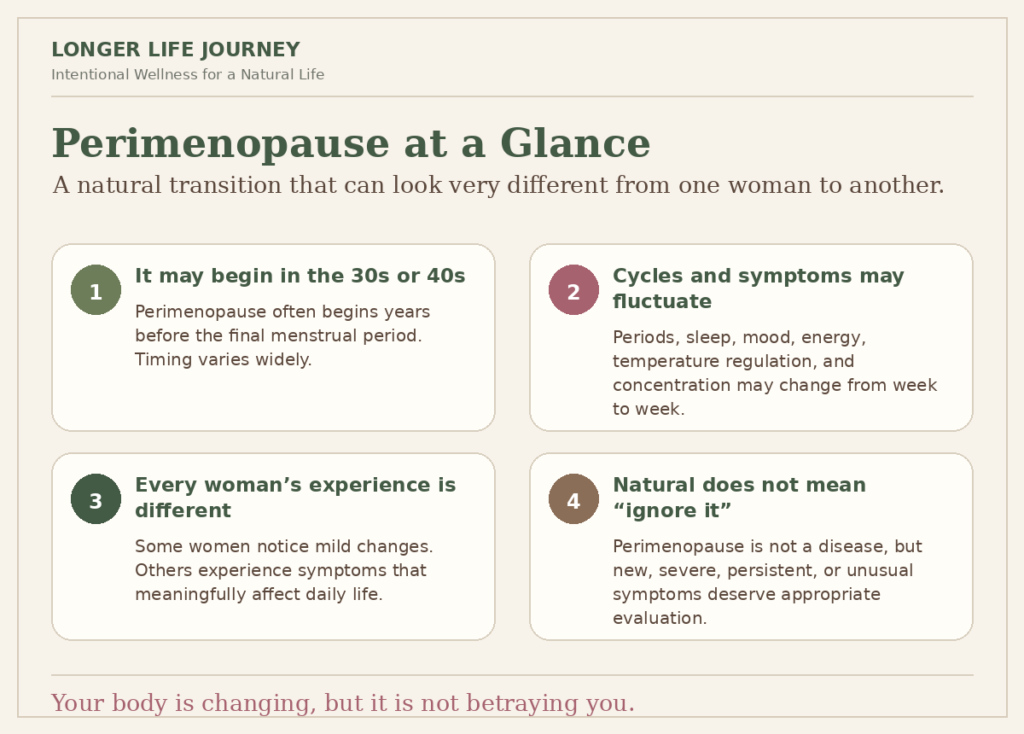
1. Begin With Understanding, Not Self-Blame
Perimenopause is not a disease or a personal failure. It is a natural biological transition, although the symptoms can sometimes disrupt work, sleep, relationships, confidence, and everyday life.
Some women notice only modest changes. Others experience symptoms that affect almost every corner of their day. Neither experience makes one woman stronger or weaker than another.
Try replacing:
“What is wrong with me?”
with:
“What may be changing, and what does my body need from me now?”
That small shift opens the door to curiosity instead of judgment.
It is also important not to assume that every new symptom is automatically caused by perimenopause. Thyroid conditions, anemia, sleep disorders, medication effects, depression, anxiety, and other health concerns may cause similar symptoms. New, severe, persistent, or disruptive symptoms deserve appropriate evaluation.
A gentle reminder
You do not need to panic over every change—but you do not have to dismiss yourself, either.
2. Nourish Your Body Consistently
This is not the season for punishing diets, skipping meals all day, or declaring war on your changing body.
Your body needs nourishment.
A supportive eating pattern may include:
- Protein-rich foods
- Vegetables and fruit
- Fiber-rich whole foods
- Healthy fats
- Calcium-containing foods
- Adequate fluids
- Regular meals rather than long stretches of accidental under-eating
There is no single perfect “perimenopause diet.” Your needs may be influenced by your medical history, digestion, activity level, medications, blood-sugar regulation, food preferences, cultural traditions, and budget.
Begin with consistency before complexity.
Notice how you feel after meals. Do certain foods help you feel satisfied and steady? Does too much caffeine make you restless or intensify hot flashes? Does alcohol make it easier to fall asleep but harder to remain asleep? Are you eating enough earlier in the day, or arriving at evening completely depleted?
This is not about labeling foods as good or bad.
It is about learning what helps your body feel nourished and supported.
3. Protect Sleep Without Turning It Into Another Job
Sleep may become less predictable during perimenopause. Hot flashes, night sweats, mood changes, pain, bladder symptoms, and changing sleep patterns may all play a part.
Unfortunately, the harder we try to force sleep, the more elusive it can sometimes feel.
Instead of trying to control every minute of the night, build a calmer setting around sleep.
Helpful starting points may include:
- Keeping the bedroom comfortably cool
- Limiting caffeine later in the day
- Avoiding very large meals immediately before bed
- Recognizing that alcohol may disrupt sleep later in the night
- Moving regularly during the day
- Creating a simple wind-down routine
- Turning the clock away when watching the time increases anxiety
The National Institute on Aging recommends practical measures such as regular movement, a comfortable bedroom temperature, and avoiding late caffeine, large bedtime meals, and alcohol when sleep is disrupted during the menopause transition.
Do not judge your entire day by one difficult night.
On a poorly rested day, support may mean lowering unnecessary demands, eating consistently, stepping outside for fresh air, moving gently, and allowing yourself to recover without turning exhaustion into another personal failure.
Persistent insomnia deserves attention. You do not have to accept months or years of poor sleep as something you should simply endure.
4. Move in Ways That Respect the Body You Have Today
Movement should support your life—not punish you for having a body.
Walking, mobility exercises, resistance training, gardening, dancing, yoga, tai chi, aquatic exercise, and chair-assisted movement can all have a place.
The best movement is not necessarily the hardest workout. It is movement that is appropriate for your health, accessible to you, and realistic enough to continue.
Some days may call for strength training. Other days may call for stretching, a slow walk, ten minutes of gentle movement, or rest.
A useful question is:
“What kind of movement would help me feel more capable when I finish than I did when I began?”
Start there.
You do not need to earn your meals, punish your body, or force yourself through pain to benefit from movement.
Consistency, enjoyment, and appropriate progression matter more than punishment.
5. Notice Patterns Without Becoming Obsessed With Them
Perimenopause can feel random, but simple tracking may reveal relationships that are difficult to recognize from memory alone.
You might record:
- Menstrual bleeding or spotting
- Cycle length
- Sleep quality
- Energy
- Mood and stress
- Hot flashes or night sweats
- Headaches or body discomfort
- Digestion
- Movement
- Caffeine and alcohol
- Medication, herb, or supplement changes
- What appeared to help
Tracking hot flashes and possible triggers is one practical strategy recommended by the Office on Women’s Health.
Tracking cannot tell you exactly what your hormones are doing, and it does not prove that one food, stressful event, or supplement caused a symptom.
What it can do is help you arrive at a healthcare appointment with something more useful than:
“I just haven’t felt right lately.”
You may begin to notice that sleep is consistently worse before bleeding, headaches increased after a medication change, or hot flashes became more disruptive during especially stressful weeks.
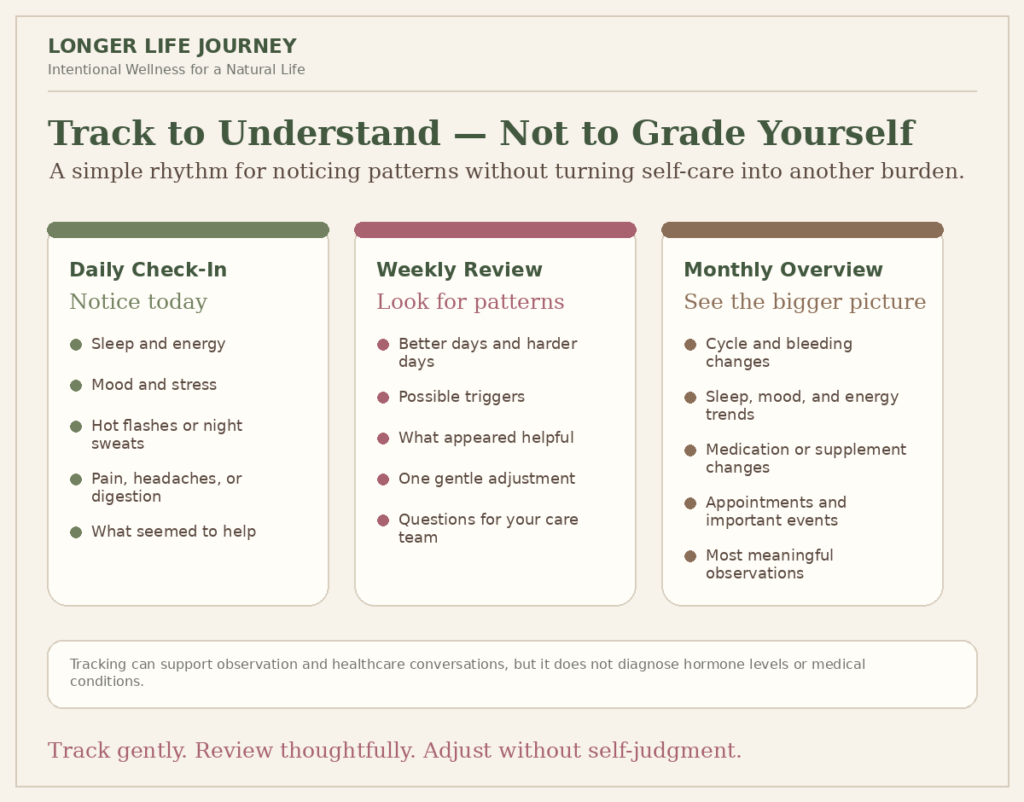
Track to understand—not to grade yourself.
6. Approach Herbs and Supplements With Respect
Herbs have been used across generations and healing traditions, but natural does not automatically mean harmless, appropriate, or effective for every woman.
Evidence for many herbs and supplements marketed for menopause symptoms remains limited or inconsistent. Products may also differ in identity, strength, purity, and dosage. Some may interact with medications or be inappropriate for women with liver concerns, bleeding risks, hormone-sensitive conditions, or other health considerations.
Before adding an herbal product:
- Know the exact herb and plant part being used
- Review the dose and quality of the product
- Consider medications and existing conditions
- Add one new product at a time
- Record why you are using it
- Set a date to evaluate whether it is helping
- Tell your healthcare professionals what you take
Do not hide herbs or supplements from your physician or pharmacist. They are part of your health picture.
Responsible herbalism is not simply asking:
“What herb is good for menopause?”
It is asking:
“Is this particular herb appropriate for this particular woman, in this preparation and dose, alongside everything else she is taking?”
That is a much wiser question.
7. Speak Up and Personalize Your Support
You are allowed to ask questions.
You are allowed to say that a symptom is disrupting your life.
You are allowed to request an explanation, discuss treatment options, ask about risks and benefits, bring a written symptom record to an appointment, or seek another opinion when you do not feel heard.
Support does not have to be entirely natural or entirely medical.
Depending on your symptoms, history, preferences, and risk factors, options may include:
- Lifestyle and nutritional support
- Counseling or stress-management strategies
- Pelvic-health care
- Nonhormonal medications
- Hormonal therapies
- Vaginal treatments
- Sleep-focused support
- Complementary practices
Medical treatments can help relieve several perimenopausal and menopausal symptoms, but the most appropriate option depends on the individual woman rather than a one-size-fits-all formula.
The goal is not to prove that one healing philosophy is superior.
The goal is to help you make informed decisions with qualified support.
A Note About Changing Bleeding
Periods often become less predictable during perimenopause, but bleeding changes should not automatically be dismissed.
Talk with your healthcare professional about new or concerning bleeding—particularly bleeding that is unusually heavy, lasts longer than expected, occurs between periods, happens after sex, or begins after menopause.
ACOG advises discussing bleeding changes during perimenopause and seeking prompt evaluation for any bleeding after menopause.
From Babshi’s Practice
After decades in nursing, herbal practice, movement education, and women’s health, one thing has become very clear to me:
Women often suffer longer than necessary because they have been taught to minimize what they feel.
You do not need to panic over every change.
But you also do not have to smile politely while your sleep, comfort, concentration, energy, or confidence steadily disappears.
Pay attention.
Ask questions.
Gather information.
Seek help when you need it.
And please remember:
You are not broken.
This can be a time of change, certainly—but it can also become a time of deeper understanding, clearer boundaries, stronger self-advocacy, and renewed respect for the body that has carried you this far.
Your Next Gentle Step
Do not try to overhaul your entire life this week.
Choose one manageable starting point:
- Begin a simple symptom record
- Eat a nourishing breakfast
- Reduce late-day caffeine
- Take a ten-minute walk
- Schedule an overdue appointment
- Write down the questions you keep forgetting to ask
- Create a calmer bedtime routine
One thoughtful change gives you information.
Ten simultaneous changes usually give you confusion.
Begin gently, observe honestly, and adjust without self-punishment.
Looking for More Support?

I wrote 7 Steps to a Happier Perimenopause—Naturally to help women understand this transition through a practical, compassionate, whole-person lens.
The book explores supportive strategies for nourishment, sleep, movement, herbs, communication, self-advocacy, and rebuilding trust in your changing body.
Now Available as an Ebook
Introductory price: $19.97
Your purchase also includes The Perimenopause Pattern Tracker Pack, featuring printable daily, weekly, and monthly tracking pages at no additional cost.
The print edition is coming soon.
CLICK HERE FOR YOUR OFFER
Explore the Ebook and Introductory Offer
Health Disclaimer
This content is for general educational purposes only and is not intended to diagnose, treat, cure, or prevent any disease or medical condition. It does not replace individualized advice, diagnosis, or treatment from a qualified healthcare professional. Seek appropriate medical care for severe, persistent, unusual, or rapidly changing symptoms.
AI-Assistance Disclosure
This content was created with the assistance of artificial intelligence and reviewed, edited, and approved by Babshi, drawing on her professional background in nursing, herbalism, movement education, and whole-person wellness.