
Menopause is not a disease, and you are not broken. Still, the changes can be uncomfortable, confusing, and disruptive enough to send almost any woman searching for support.
Hot flashes, restless nights, shifting moods, fatigue, changing body composition, and that frustrating feeling of not quite recognizing yourself can all occur during the menopausal transition. Some women use hormone therapy. Others prefer nonhormonal care, cannot use hormones, or want to begin with nutrition, movement, stress support, herbs, and supplements.
Increasingly, products containing functional or medicinal mushrooms are being marketed to women during menopause. These formulas often include familiar names such as reishi, cordyceps, lion’s mane, shiitake, maitake, turkey tail, and chaga.
But what do we actually know about these mushrooms—and what should a woman consider before buying a menopause supplement that contains them?
First, Menopause Is More Than One Hormone
Menopause is often described as though estrogen drops one day and causes a predictable list of symptoms. In real life, the transition is rarely that tidy.
During perimenopause, hormone levels can fluctuate considerably. Sleep, stress, thyroid health, blood-sugar regulation, nourishment, medication use, activity level, emotional well-being, and a woman’s personal health history may all influence how she feels.
This is why one product is unlikely to be the entire answer.
A supplement may become one part of a thoughtful wellness plan, but it should not replace a broader look at what the body is asking for. Persistent, severe, unusual, or rapidly changing symptoms also deserve appropriate medical evaluation.
Why Are Mushrooms Showing Up in Menopause Formulas?
Certain mushrooms have a long history of culinary and traditional use, particularly in Asian wellness traditions. Modern researchers have also investigated compounds found in mushrooms, including polysaccharides, beta-glucans, triterpenes, and other naturally occurring constituents.
Much of the excitement around these compounds comes from laboratory and animal research examining immune activity, inflammation, metabolism, cognition, energy, and stress response. However, results from a laboratory, an animal study, or a study of one isolated mushroom cannot automatically be applied to a multi-ingredient menopause supplement.
That distinction matters.
Different products may use:
-
- The fruiting body, mycelium, or both
-
- Whole mushroom powder or concentrated extracts
-
- Different extraction methods
-
- Different species or strains
-
- Widely different amounts
-
- Proprietary blends that do not reveal the amount of every ingredient
These differences can make two products bearing the same mushroom name quite unlike one another.
What Does the Human Research Tell Us?
There is some early and interesting research, but it is nowhere near strong enough to promise that medicinal mushrooms will balance hormones or reliably stop menopausal symptoms.
One small four-week study involved 30 women and examined foods containing lion’s mane mushroom. Researchers reported improvements in some measures of depression, anxiety, and nonspecific complaints. This was a small preliminary trial, however, and it did not study Menovelle or establish lion’s mane as a treatment for menopause.
Research involving cordyceps and menopause-related changes has largely involved ovariectomized rats rather than women. Animal studies can help researchers identify possibilities, but they cannot establish that the same results will occur in humans—or that a commercial supplement containing a different form and dose will produce those effects.
The Menopause Society’s 2023 position statement did not recommend supplements and herbal remedies as established treatments for menopausal hot flashes because the available evidence was insufficient or inconsistent. That does not prove that no individual woman will ever notice a benefit. It means that we do not currently have enough dependable evidence to guarantee results.
A Closer Look at Menovelle
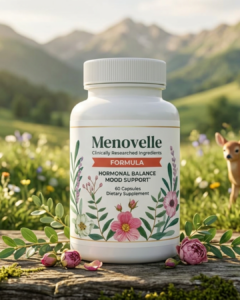
Menovelle is a dietary supplement marketed to women navigating menopause. Its formula includes ten mushroom ingredients:
-
- Cordyceps sinensis
-
- Reishi
-
- Shiitake
-
- Lion’s mane
-
- Maitake
-
- Turkey tail
-
- Chaga
-
- Royal Sun Agaricus
-
- White button mushroom
-
- Wood ear, also called black fungus
According to the Supplement Facts panel, one serving is two vegetable capsules. The formula provides 266 milligrams each of cordyceps mycelium powder, reishi fruiting-body extract, shiitake fruiting-body extract, and lion’s mane fruiting body.
It also contains a 266-milligram proprietary blend shared among maitake, turkey tail, chaga, royal sun agaricus, white button mushroom, and wood ear fungus. The product page lists these ten mushrooms, while the label supplies the serving information and identifies which ingredients are included in the proprietary blend.
What a Proprietary Blend Means
A proprietary blend tells us the total amount of the blend but not how much of each ingredient it contains.
In this case, the six mushrooms in the proprietary blend total 266 milligrams per serving. The label does not tell us how that amount is divided.
This does not automatically mean that the product is poor quality. It does mean that a consumer cannot compare the amount of each blended mushroom with the quantities used in published research.
The manufacturer’s reference page provides research about selected ingredients, menopause, body composition, and related subjects. However, it does not list a human clinical trial of the complete Menovelle formula. Much of the menopause-specific mushroom research cited by the manufacturer involves laboratory work or animal models rather than clinical trials of the finished product in menopausal women.
That is why I would describe Menovelle as a mushroom-based supplement marketed for menopause support, not as a clinically proven treatment for hot flashes, weight gain, hormonal imbalance, or any other medical condition.
Be Wary of Dramatic Hormone and Weight-Loss Claims
The Menovelle sales page uses strong language about “estrogen-eating fat cells,” activating an “estro-gene,” releasing trapped estrogen, losing belly fat, and restoring hormonal balance. Those statements are part of the manufacturer’s advertising presentation, but its published references do not establish that the finished supplement produces those results in women.
Menopause can influence where body fat is stored and is associated with changes in body composition, but that does not demonstrate that fat cells “eat” or imprison estrogen in the way the advertising language suggests.
This is one of those moments when we need to separate an interesting product from an exaggerated story used to sell it.
A supplement should never make a woman feel that her body has betrayed her—or that a bottle is the only thing standing between her and a “blissful” menopause.
Natural Does Not Automatically Mean Risk-Free
Medicinal mushrooms contain biologically active compounds. That is part of why people are interested in them, but it is also why safety deserves attention.
The FDA advises consumers to discuss supplements with a physician, pharmacist, nurse, dietitian, or another qualified professional because supplements can interact with medicines, other supplements, laboratory tests, and procedures. The FDA does not approve supplements for safety and effectiveness before they enter the marketplace.
Extra caution is sensible when a person:
-
- Takes prescription or over-the-counter medication
-
- Uses blood-thinning, glucose-lowering, or immune-modifying treatment
-
- Has an autoimmune disorder, liver condition, bleeding disorder, or chronic illness
-
- Is preparing for surgery or a medical procedure
-
- Has a known mushroom or mold allergy
-
- Is pregnant or nursing
-
- Is already taking several herbs or supplements
There have also been rare reports of liver injury associated with reishi products, although short-term human trials have generally reported few adverse effects. Rare does not mean inevitable, but it does remind us to pay attention to new nausea, dark urine, unusual fatigue, abdominal pain, itching, or yellowing of the skin or eyes after beginning any new supplement.
Questions to Ask Before Choosing a Mushroom Supplement
A beautiful label and a long ingredient list do not tell the whole story. Before buying, consider asking:
1. Does the label identify the exact species?
Common mushroom names are not always specific enough. A scientific name helps identify what is actually being used.
2. Is it made from the fruiting body or the mycelium?
One is not automatically superior in every situation, but research performed with one part of a mushroom may not apply to a product made from another.
3. Are the amounts disclosed?
A fully disclosed formula allows you to see how much of each ingredient is present. A proprietary blend does not.
4. Is the extract standardized?
Some manufacturers state the concentration, extraction ratio, or measurable beta-glucan content. Menovelle’s label does not provide that level of detail.
5. Is independent testing available?
A responsible company should be able to explain how it verifies identity, purity, contamination limits, and label accuracy. “Manufactured in an FDA-registered facility” is not the same thing as the FDA approving the product or confirming that it works. The FDA does not approve manufacturing facilities or dietary supplements in that way.
6. Does the advertising promise more than the evidence supports?
Phrases such as “breakthrough,” “effortless weight loss,” “reactivates your genes,” and “balances all your hormones” deserve a raised eyebrow.
Hope is valuable. Hype is something else entirely.
Could Menovelle Still Be Worth Considering?
Possibly—for the right woman, with realistic expectations and appropriate safety screening.
Menovelle offers several mushroom ingredients in one capsule formula. A woman who is specifically interested in functional mushrooms may appreciate that convenience. However, she should understand that:
-
- It is a dietary supplement, not hormone therapy.
-
- It has not been shown to cure menopause or correct every hormonal change.
-
- Research on individual mushrooms does not prove that the complete formula works.
-
- The six-ingredient proprietary blend does not disclose individual amounts.
-
- Results, if any, will differ from woman to woman.
-
- It should be considered alongside—not instead of—appropriate medical care, nourishment, restorative sleep, movement, stress support, and symptom tracking.
When trying any new supplement, introduce one major change at a time when practical. Record the starting date, dose, symptoms, medications, sleep, energy, mood, digestion, and any reactions. A written record is far more useful than trying to remember later whether something truly helped.
The Bottom Line
Medicinal mushrooms are an interesting area of study, and some early findings deserve further investigation. But women deserve more than dramatic promises built from preliminary science.
Menopause support should be personal, informed, and whole-person.
You are not failing because your body is changing. You are not required to suffer silently, and you are not required to buy every product that promises to make the transition disappear.
Learn what is in the bottle. Ask questions. Discuss potential interactions. Pay attention to your own body. Then choose from a place of knowledge rather than fear.
Interested in Learning More About Menovelle?
We have prepared a separate product overview that includes ingredient information, cautions, an affiliate disclosure, and access to the manufacturer’s current offer.
Affiliate Disclosure
Longer Life Journey and Healing Haven Oasis may earn a commission when a reader purchases Menovelle through a link on this website, at no additional cost to the purchaser. Affiliate relationships do not change our commitment to discussing products honestly, identifying important limitations, and encouraging informed decisions.
Health Disclaimer
This article is provided for general educational purposes and is not medical advice. It is not intended to diagnose, treat, cure, or prevent any disease or to replace individualized care from a qualified healthcare professional. Speak with your physician, pharmacist, or other appropriate practitioner before using a dietary supplement, particularly if you take medication, have a medical condition, are preparing for surgery, or are pregnant or nursing.
AI-Assistance Disclosure
This article was developed with AI-assisted research and editorial support. The final content is reviewed and shaped to reflect Babshi’s professional background in nursing, herbalism, movement education, and whole-person wellness.